
Letters to June
As a child I knew exactly what I wanted to do with my life. Now, I am learning to embrace chaos.

Dear reader,
I turn 35 tomorrow, and sometimes, it feels like I am still figuring out the answer to what I want to do when I grow up.
As a child, I was always so sure. I knew exactly what I wanted to do.
This isn’t memory cosplaying as an unreliable narrator and emotionally manipulating me as I inch towards the trickier side of the thirties. This is fact. I have diary entries from the late 2000s and early 2010s that lay out my ideas and options. Well-thought out, and more often than not, based in reality.
But as an adult, things change every week. I find myself reevaluating choices that were set in stone and recalibrating my priorities to factor in geopolitical and environmental upheavals.
In January 1856, Emily Dickinson was ‘out with lanterns looking for herself’.1 In June 2026, as I look at Venus and Jupiter draw closer to each other in the sky, I wish there was a way to ask her if she was successful.
In one of my most favourite poems, The Summer Day, Mary Oliver asks the most important question we will ever dwell on—
“Tell me, what is it you plan to do
with your one wild and precious life?”2
Sometimes, when I am trying to figure out what I want this life to look like, Sylvia Plath’s fig tree3 immediately comes to mind. I picture myself looking at a fig tree and instead of giving in to indecision and letting the figs rot, I pluck them all.
In my dreams, I bend reality to have my figs and eat them too. Greedy? Maybe. Selfish? Yes. Thank you.
Perhaps this is how one has fun as an adult. After all, one of the biggest rug-pulls of growing up is realising that nobody has the answers and perhaps there isn’t even such a thing as a right answer.
I’ve also been thinking back to all the questions I had, dozens and dozens of them, every day as a child. Silly ones about the sky and the sun, logistical ones around food and schedules, and deeper ones about death and the places women have for themselves. How did my parents have the answers? Magically plucking them out of thin air, just ripe, invariably sweet. Each answer making me want another.
I have been trying to learn how to do this for myself, and to savour the answers I find.
In Maggie O’Farrell’s sublime historical fiction novel ‘Hamnet’4, she writes,
“Gardens don’t stand still: they are always in flux. The apple trees stretch out their limbs until their crowns reach higher than the wall. The pear trees fruit the first year, but not the second, then again the third. The marigolds unfold their bright petals, unfailingly every year, and the bees leave their skeps to skim over the carpet of blooms, dipping into and out of the petals. The lavender bushes in the knot garden grow leggy and woody, but Agnes will not pull them up; she cuts them back, saving the stems, her hands heavy with fragrance.”
This is true for a life too. It is, always, in flux, each of its parts finding a rhythm of their own. Perhaps then, like the evolving nature of a garden, the right answer is simply whatever the lantern finds in that moment.
Some reminders as I turn 35 that I hope to keep returning to:
Good writers are just bad writers who didn’t stop writing. Not giving up when this craft feels like it is going to be impossible, matters more than anything else. Because it is impossible to write a fabulous first draft if you are also juggling a grocery list, people’s preferences, managing a home and trying to make money. Be kinder to yourself. Stay with the bad drafts. Give it time. They will turn into something better. Even in life, perhaps, you think you know why you are so angry, but in a month, you’ll know what it really is. Time is the distance you need.
One of the most challenging aspects of ageing and also being chronically online, is choosing how you want to view yourself. If you determine your worth based on how others view you, you will always feel unworthy. But given the amount of time you spend on the internet, this is inevitable. You will, every now and then, hate yourself based on something that has nothing to do with you and everything to do with other people. When it happens, can you forgive yourself?
You will lose people. People who touch your lives everyday and people you haven’t thought about in years. And sometimes, the grief that takes you by surprise, the grief you didn’t anticipate or plan or prepare for, that is the grief that is hardest to shake off.
Everyone has a narrative about your life in their heads. Some people will smirk when you talk about your life and your future. Nothing you do will change that. Remember how you fought with your parents because they were worried about what people would think of your clothes or the way you spoke about the difficult things or who you met? Let that brave sixteen-year-old girl take centerstage in your mind more often. You need her.
Capitalism has us tethered to believing there is only path—the pursuit of money, which will lead us to happiness, joy, contentment and the absence of fear. But after a point, the pursuit of money only leads to the pursuit of more money, and the fear of losing that money.
It is okay to be exhausted. Your thirties have largely been about being tired. Of the way the world continues to do more harm than good. Of how bleak the future seems. Of how much you still need to get done before you go to bed tonight. Of how tired you are of being tired all the time. The best thing about seeing and accepting that you are exhausted? You are finally ready to take care of yourself.
This need to overthink is both hereditary and circumstantial. To some extent, it is also what makes you a better writer. But how do you ensure your questions don’t end up as full stops for your dreams? You will not have all the answers, but if you move from mind to body to breath, if you exhale and then inhale, your breath will be the compass you need.
In Ada Limon’s poem ‘I Remember The Carrots’ there is a line that stopped me in my tracks. “I’m thirty-five and remember all that I’ve done wrong.”5
It is true. We all tend to remember our mistakes, our flaws, our heartbreaks. But I hope, I remember these things too.
A poem to hold onto
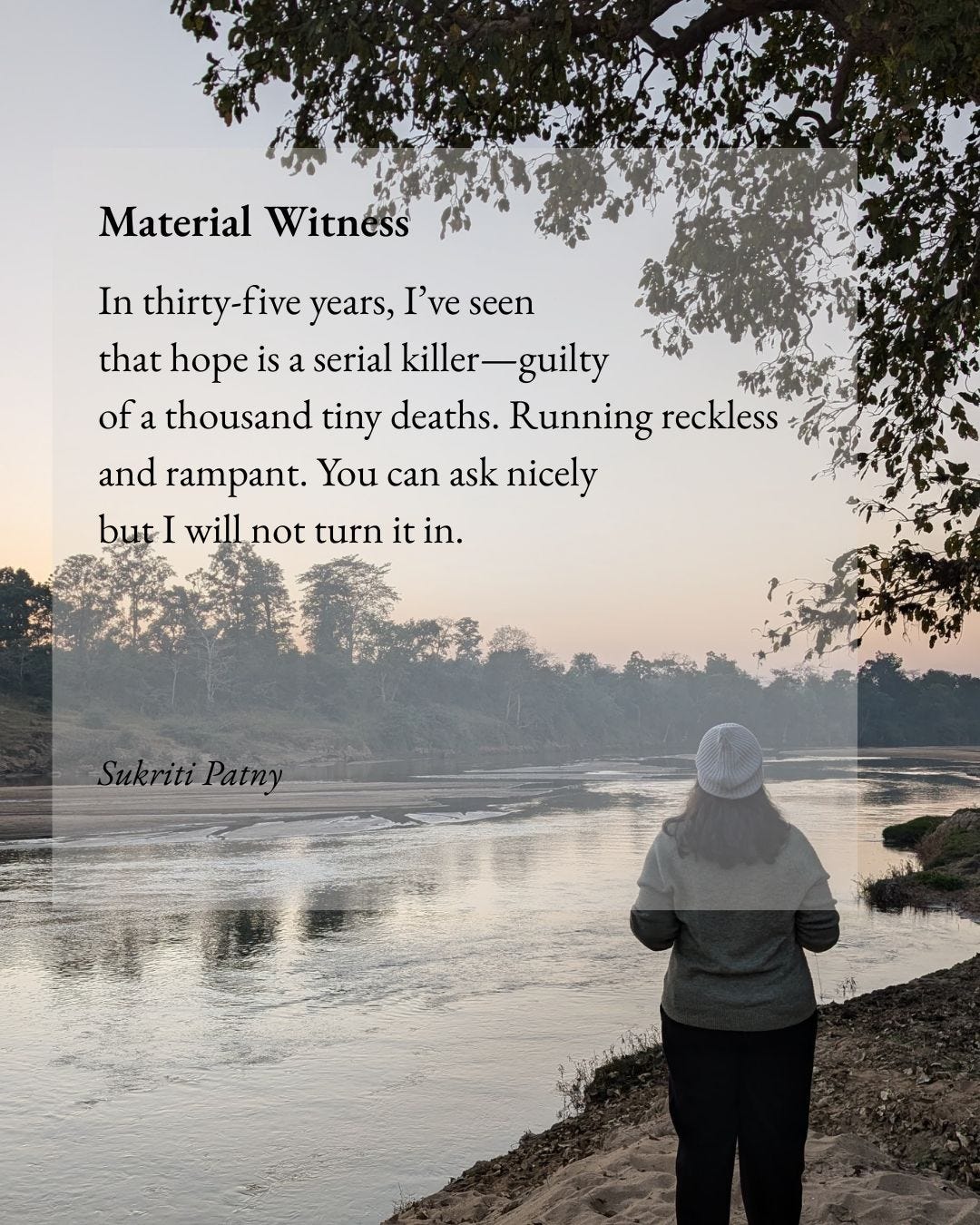
As always, thank you for taking the time to reading Half A Moon. I hope the answers that come your way, turn sweet.
I’d love to hear from you. Leave a comment, or write back to me.
Love,
Sukriti
https://archive.emilydickinson.org/correspondence/holland/l182.html
https://poets.org/poem/summer-day
https://www.goodreads.com/quotes/7511-i-saw-my-life-branching-out-before-me-like-the
https://www.goodreads.com/en/book/show/43890641-hamnet
https://www.brinkerhoffpoetry.org/poems/i-remember-the-carrots
Hi Sukriti
All of these are good reminders, at 65 as much as at 35.
Also - the thing about Hope is this: it is far better than despair.
Best Wishes - Dave :)